
ANAFRIC, the meat industry association, has concluded an intense institutional agenda in Brussels with representatives of the European Parliament and the Catalan Government’s Delegation to the European Union, with a clear message: the competitiveness of the European livestock and meat sector must be guaranteed through fair competition, effective import controls, and greater regulatory reciprocity in trade agreements with third countries.
The ANAFRIC delegation, comprised of its president, José Friguls, vice president Antoni Jové, and the association’s representative in Brussels, Rosa Solanes, held several working meetings to convey the sector’s concerns regarding the regulatory, trade, and health challenges that will shape the future of European livestock production.
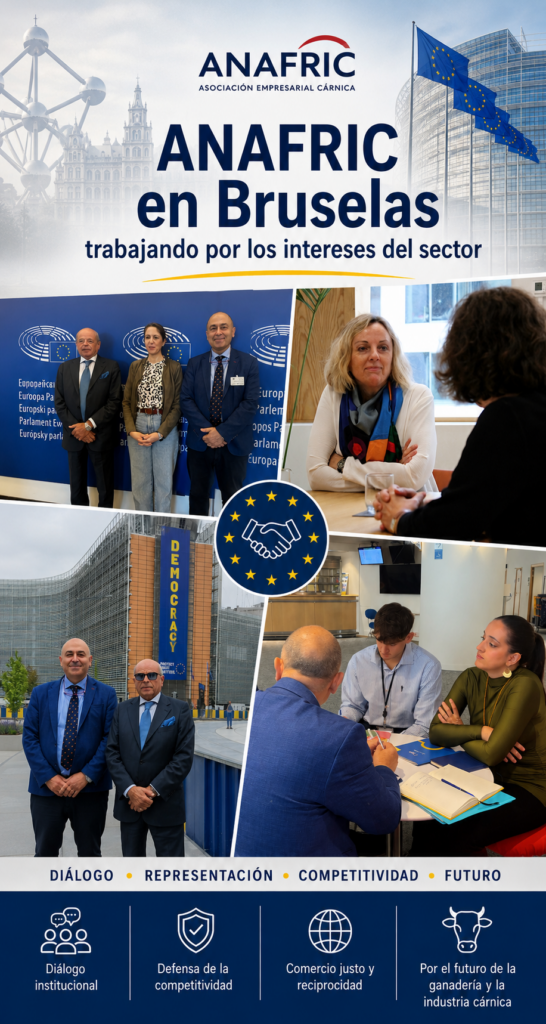
During their stay in Brussels, ANAFRIC met with Belén Esteve, parliamentary advisor specializing in international trade to MEP Gabriel Mato (European People’s Party Group), member of the Committee on International Trade (INTA) and substitute member of the Committee on Agriculture (AGRI); with MEP Cristina Maestre (Progressive Alliance of Socialists and Democrats Group), member of the Committee on Agriculture and Rural Development (AGRI) and the Intergroup on Sustainable Livestock Farming; and with Ester Borràs, Delegate of the Government of Catalonia to the European Union. The meetings provided an opportunity to convey the main concerns of the Spanish livestock and meat sector regarding international trade, animal health, competitiveness, and food safety.
The EU-Mercosur agreement, a major concern
One of the issues that dominated the meetings was the trade agreement between the European Union and Mercosur. ANAFRIC reiterated the need to rigorously assess the impact that these types of agreements can have on sensitive sectors such as the meat industry and called for effective protection mechanisms to address potential market distortions.
During the meetings, the importance of the safeguard clauses included in the negotiations was highlighted, as well as the need for continuous monitoring of tariff quotas to detect potential imbalances that could affect European producers.
Reciprocity and Sanitary Controls
ANAFRIC argued before European representatives that the environmental, sanitary, animal welfare, and food safety requirements that European companies meet should also apply to imported products.
The association emphasized the need to strengthen health and food safety controls at borders, ensuring that imports from third countries meet standards equivalent to those required of EU producers.
Concerns were also raised about the regulatory costs borne by the European sector to comply with animal health and disease control regulations, a burden not always shared by international competitors.
Food Safety and Sustainability
Another message championed by ANAFRIC was the need to address the trade debate from a broader perspective, incorporating aspects related to food safety, public health, sustainability, and the resilience of the European food chain.
In this regard, European institutions expressed interest in having objective data, sector reports, and impact studies that would allow for a rigorous assessment of the economic and production consequences of the trade agreements currently under negotiation.
Strengthening the Sector’s Presence in Brussels
The meetings also served to consolidate ANAFRIC’s dialogue with key European policymakers and strengthen the presence of the Spanish meat sector in the forums where policies affecting livestock production and the food industry are designed. “Europe needs to hear firsthand the realities of our companies. Only in this way can balanced decisions be made that guarantee the economic, social, and productive sustainability of the European livestock sector,” stated José Friguls.
ANAFRIC will continue to intensify its institutional activity in Brussels and collaborate with European institutions to share information, studies, and proposals that contribute to defending the competitiveness of the Spanish and European meat sector in an increasingly demanding and globalized context.