In 2025, the sector produced more than 9.2 million animals for sale, exported nearly 1.1 million live animals, and shipped 55,864 tons of meat to international markets.
Almost one out of every two tons of available meat was sold outside of Spain, while the sector faces a reduction in its production base, with a 5.2% decrease in the livestock population and a 10.5% decrease in the number of animals produced for sale.
Madrid, September 1, 2026 – INTEROVIC, the Interprofessional Agri-food Organization for Sheep and Goat Meat, has prepared an overview of the sector based on the latest “Economic Indicators of the Sheep and Goat Meat Sector,” published last July by the Ministry of Agriculture, Fisheries and Food (MAPA), corresponding to 2025.
Based on this official data, which compiles the main indicators on Censuses, production, slaughter, foreign trade, and consumption: INTEROVIC has conducted a comprehensive analysis of the sector’s flow to show what happens from the moment animals leave the farms until the meat reaches the Spanish consumer or is sold in international markets.
The results highlight the significant marketing capacity and international presence of Spanish sheep and goats, and, on the other hand, the progressive reduction of their production base.
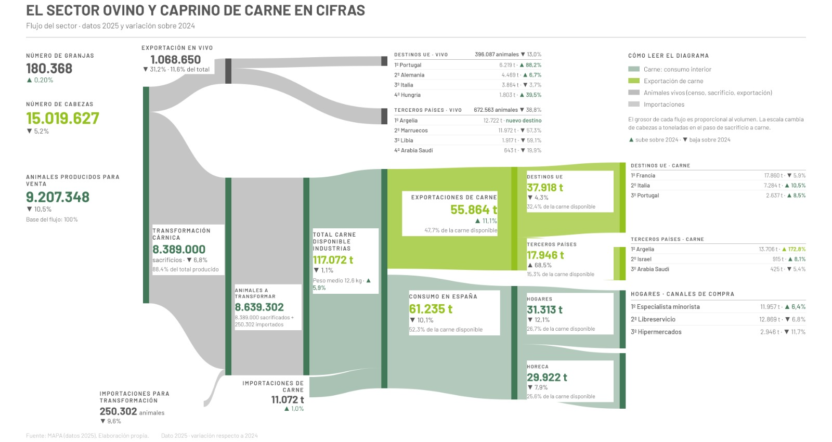
Spain has 180,368 farms and a census of 15,019,627 sheep and goats. In 2025, 9,207,348 animals were produced for sale, 10.5% fewer than the previous year.
Of these, 1,068,650 were exported live, representing 11.6% of the animals produced for sale. Another 8,138,698 domestically raised animals were slaughtered in Spain, in addition to 250,302 imported animals. In total, 8,389,000 animals were processed, generating 117,072 tons of meat available for the industry.
Almost half of every two tons is destined for international markets.
One of the figures that best reflects the commercial scale of the sector is the share of meat exports. Of the 117,072 tons available, 55,864 tons were destined for international markets, approximately 47.7% of the total.
The European Union continues to be the main export market, with 37,918 tons, equivalent to 32.4% of all available meat. France, Italy, and Portugal are the leading destinations within the EU.
These figures are in addition to another 17,946 tons destined for third countries, representing 15.3% of the available meat.
Among these markets, Algeria stands out, becoming the leading non-EU destination for sheep and goat meat in 2025, with 13,706 tons, a 172.8% increase over the previous year.
The export of live animals also remains significant. Of the 1,068,650 animals exported during 2025, 672,563 went to third countries and 396,087 to European Union markets.
The Spanish market absorbs more than half of the available meat.
While 47.7% is destined for export, 52.3% of the available meat remains in the domestic market, with a volume of 61,235 tons.
The distribution between the two main consumption channels is practically balanced. Households account for 31,313 tons, while the HORECA channel represents another 29,922 tons.
The data, however, reflect a downward trend compared to 2014, when household consumption decreased by 12.1%, while consumption in the HORECA channel fell by 7.9%.
Within household consumption, self-service is the main channel, with 12,869 tons, followed by specialist retailers, with 11,957 tons, and hypermarkets, with 2,946 tons.
Fewer animals and a growing focus on export markets
A combined analysis of the indicators published by the Ministry of Agriculture, Fisheries and Food (MAPA) reveals one of the main challenges currently facing the sheep and goat meat sector.
While the livestock population decreased by 5.2% and the number of animals produced for sale fell by 10.5% compared to the previous year, meat exports increased by 11.1%.
As Tomás Rodríguez, director of INTEROVIC, points out, “this trend demonstrates the capacity of the Spanish supply chain to market its products and find markets both within and beyond our borders. However, at the same time, it is necessary to maintain a sufficient production base to meet future demand.”
The combined data also clearly illustrates the relative importance of the different sales channels: approximately half of the available meat is consumed in Spain.
“This sector has markets both within and outside of Spain. The challenge is to ensure that this capacity to generate demand and value is transferred throughout the entire chain and contributes to maintaining the farms, the animals, and the economic activity that sheep and goat farming generates in our regions,” says Tomás Rodríguez, director of INTEROVIC.
With this analysis, INTEROVIC transforms the various official indicators published by the Ministry of Agriculture, Fisheries and Food (MAPA) into an integrated view of the sheep and goat meat supply chain, facilitating an understanding of how Spanish production is distributed and providing a tool to analyze the challenges and opportunities facing the sector.
Source: Economic indicators of the sheep and goat meat sector. Ministry of Agriculture, Fisheries and Food (MAPA), 2025 data. Flow analysis and representation: INTEROVIC.