
On World Environment Day, celebrated today, PROVACUNO is highlighting 10 key measures to preserve and conserve the soil on livestock farms across Europe, as part of its ‘For a Sustainable Europe’ campaign. This special mission for the beef sector is being carried out in conjunction with the Apaq-W association (Belgium) and is co-financed by the European Union.
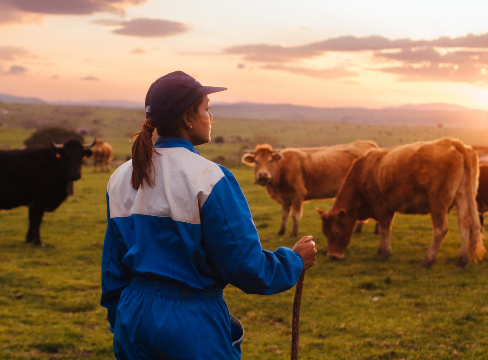
These are a series of improvements that make farms more efficient, while also reducing resource consumption and improving their environmental performance. Among these resources, there is one that underpins everything and often goes unnoticed: the soil.
The soil, the foundation of the system and key to efficiency
In beef cattle farming, the soil determines the capacity to produce pasture, retain water, recycle nutrients, and support the entire production system. Degraded soil loses fertility and reduces productivity. Conversely, well-managed soil improves efficiency and long-term viability, a key factor in modern livestock farming.
Many decisions that improve farm efficiency, such as adjusting stocking rates, managing pasture rotation, and maintaining vegetation cover, have a direct impact on the soil: they prevent degradation, improve its structure, and increase its organic matter content. The effect is twofold, as they facilitate higher yields while causing less environmental impact.
10 key measures to preserve and improve soil in extensive livestock farming:
- Planned rotational grazing: Dividing the farm into paddocks and alternating their use with rest periods to avoid overgrazing and stimulate plant regeneration.
- Controlled instantaneous stocking rate: Concentrated grazing in short periods, considering the land’s carrying capacity, to promote the incorporation of organic matter, nutrient recycling, and surface aeration without compacting the soil.
- Adaptive management according to climate and production: Adjust grazing to the seasonal evolution of pastures to reduce the risk of degradation and optimize their productivity.
- Sowing strategic cover crops: Plant native perennial grasses and legumes in degraded areas to reduce erosion, improve infiltration, and increase fertility and organic matter content.
- Maintenance of vegetation islands and field margins: Conserve pockets of functional biodiversity and refuges for pollinating and insectivorous fauna, which, in the long term, help improve soil productivity.
- Technical application of compost and manure: Use well-stabilized amendments, applied according to crop needs and, in extensive systems, with uniform distribution thanks to mobile grazing.
- Avoid unnecessary deep tillage: Preserve soil structure, aggregates, and mycelial networks that support microbial life and prevent soil loss through runoff. Water harvesting techniques: Implement micro-dams, infiltration trenches, and biological decompaction with deep roots to improve infiltration and water storage.
- Regeneration and protection of native trees: In silvopastoral systems such as dehesas (Mediterranean oak woodlands), appropriate pruning of holm oaks, cork oaks, and gall oaks is recommended, along with increased protection against animal browsing, to improve the long-term resilience of these systems.
- Ongoing soil monitoring: Establish a baseline and conduct periodic analyses (organic matter, nutrient content, pH, bulk density) along with the observation of simple biophysical indicators (earthworm presence, infiltration, vegetation cover) to optimize management and fertilization.
A shared commitment to climate neutrality
Soil plays a central role in reducing emissions, since a higher organic matter content promotes carbon storage, improves productive efficiency, and reduces nutrient losses. Therefore, mitigation strategies in beef cattle necessarily involve improved soil management. Reducing emissions, improving efficiency, and preserving this resource are objectives that go hand in hand, supported by scientific knowledge and the sector’s capacity to incorporate new practices. The sustainability of beef cattle is built upon a series of improvements that affect the entire production system.
These recommendations are part of the Sustainable European Beef (SEUB) program, which is being developed from 2025 to 2027 with co-financing from the European Union and the participation of Provacuno (Spain) and Apaq-W (Belgium). The program includes actions aimed at the public to increase awareness of the EU model production lines and their sustainability, as well as raising awareness about the role of consumers in the EU’s 2050 climate neutrality goal; as well as actions aimed at the professional sector, with support in the form of training, technical information, and knowledge-sharing spaces to promote the adoption of best practices.
More information about the campaign can be found on the website www.vacunosostenible.eu.
Más información sobre la campaña en la página web www.vacunosostenible.eu.