
- On October 30th, Spain celebrates World Offal Day—a day dedicated to its most visceral ingredients, highlighting their gastronomic, sustainable, and cultural value.
- From the veal sweetbread trilogy at Rural to the pig’s face at Atrio, four renowned restaurants demonstrate that offal—whether from beef, pork (including Iberian pork), rabbit, lamb, or poultry—deserves a place at any table.
- This date falls within the third edition of the “Un País de Casquería” (“A Country of Offal”) initiative, promoted by the Livestock and Meat Forum (Foro Ganadero Cárnico) with the support of various interprofessional meat organizations.
Offal—a hallmark of traditional Spanish cuisine—is celebrated on Friday, October 30th, as part of World Offal Day, reaffirming its role in contemporary gastronomy. This year, the celebration takes place where it is best showcased: on the plate. As part of the third edition of the “Un País de Casquería” initiative—promoted by the Livestock and Meat Forum with the backing of the Ministry of Agriculture, Fisheries and Food through the “Alimentos de España” (“Foods from Spain”) strategy—five top-tier chefs from across Spain present six dishes. These offerings range from grilled preparations to slow-cooked recipes, and from snacks to spoon-served courses, all featuring offal from beef, pork (including Iberian pork), rabbit, lamb, or poultry.
Six dishes, six distinct ways to interpret and celebrate offal
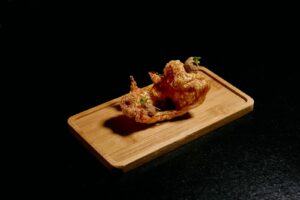
At Rural (Madrid), chef Rafa Zafra highlights his veal sweetbread trilogy—one of the most iconic dishes at his meat-focused restaurant. Beef sweetbreads prepared in three ways and with three distinct textures: battered and served with a spicy “diabla” mayonnaise, grilled with chimichurri, and glazed—with the option to add a topping of caviar.
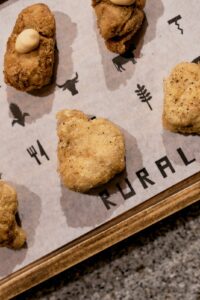
Meanwhile, at Cañitas Maite (Casas Ibáñez, Albacete), Javier Sanz and Juan Sahuquillo present a “tribute to the traditional pig slaughter.” This dish, which often opens their tasting menus, offers an avant-garde, snack-sized reinterpretation of a classic La Mancha pork-slaughter stew—traditionally made with breadcrumbs, lard, pork liver, and spices—served here on a crispy, slightly spicy corn tortilla.
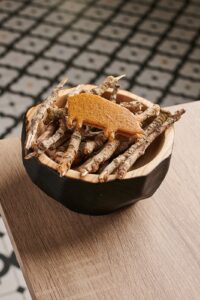
Back in the capital, at La Tasquería (Madrid), Javi Estévez—a leading figure in the avant-garde approach to offal—features *chorrillo* (a specific neck muscle) of lamb, accompanied by a “liquid salad” and a pâté made from its liver. Estévez, who has been instrumental in bringing offal into the realm of haute cuisine, elevates this classic cut—once served in a rustic style at humble fry-shops in Madrid neighborhoods like Embajadores or Legazpi—to the level of a Michelin-starred dining experience.
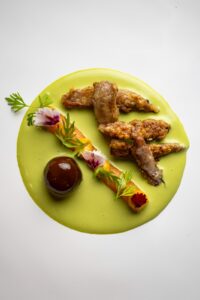
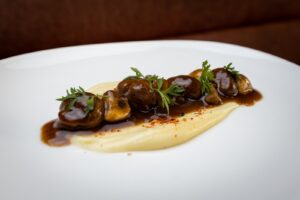
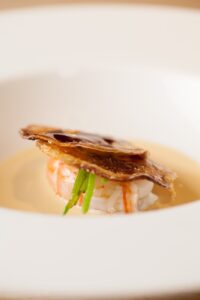
At Atrio (Cáceres), Toño Pérez features Iberian pork jowl paired with langoustines and a creamy poultry reduction. This dish is one of the historic, signature offerings at the three-Michelin-starred restaurant—a classic “surf and turf” combination that has remained on the menu for over 30 years. Iberian pork jowl is slow-cooked, rolled, and then grilled until it achieves a crispy texture—reminiscent of roasting a pig’s snout over an open fire in the countryside.
At Atrio (Cáceres), Toño Pérez features Iberian pork jowl paired with langoustines and a creamy poultry reduction. This dish is one of the historic, signature offerings at the three-Michelin-starred restaurant—a classic “surf and turf” combination that has remained on the menu for over 30 years. Iberian pork jowl is slow-cooked, rolled, and then grilled until it achieves a crispy texture—reminiscent of roasting a pig’s snout over an open fire in the countryside.
“Un País de Casquería” (A Land of Offal): A Campaign Championing Our Culinary Heritage
“Un País de Casquería” was created with the goal of reviving the gastronomic memory of a product deeply rooted in our culinary history and introducing it to new generations. Now in its third edition, the campaign seeks to highlight the value of offal through a cultural, sustainable, and modern lens, asserting its rightful place in contemporary cuisine and its contribution to a more responsible food system.
Furthermore, it underscores the virtues of offal—flavorful, nutritious, affordable, and sustainable—and advocates for its role within the Mediterranean diet and Spanish gastronomic culture. As part of this initiative, various educational activities, audiovisual materials, and digital content have been developed to explain why offal—better than any other product—embodies the principles of “nose-to-tail” cooking and the circular economy. It utilizes up to 90% of the animal, reduces food waste, and promotes a more responsible model of consumption.
Offal in Numbers
According to the latest available data from the Ministry of Agriculture, Fisheries and Food (MAPA)—drawn from the 2023 Household Consumption Panel—Spaniards consumed nearly 29,500 tons of offal, with a value of approximately 184 million euros. This represents an 8% increase compared to the previous year. Although the 2024 Food Consumption Report indicates general stability
Regarding food consumption in Spain, the consumption of offal continues an upward trend, driven by a desire for traditional flavors, sustainability, and “zero-waste” cooking—making full use of ingredients.
This growth is also supported by consumer interest in products with cultural and gastronomic value, which align with the principles of a circular economy and the complete utilization of the animal. An increasing number of chefs are reviving and reinterpreting offal, restoring it to the prominent place it deserves within contemporary Spanish gastronomy.
“We are a nation that embraces offal. We always have been, and we will continue to be, as long as there are chefs, butchers, and consumers who value the taste of the authentic,” notes José Manuel Álvarez, Communications Director for the *Foro Ganadero-Cárnico* (Livestock and Meat Forum)—the organization behind this campaign, which brings together six interprofessional meat associations (ASICI, AVIANZA, INTERCUN, INTEROVIC, INTERPORC, and PROVACUNO).
About the *Foro Ganadero-Cárnico*
The *Foro Ganadero-Cárnico* is a non-profit association that serves as an information platform regarding livestock farming and various types of meat—including beef, sheep and goat, white and Iberian pork, rabbit, poultry, and processed meat products. It aims to address topics of interest to consumers, healthcare professionals, the media, and society at large, focusing on the role that livestock production and meat play in territorial, social, and economic development.